
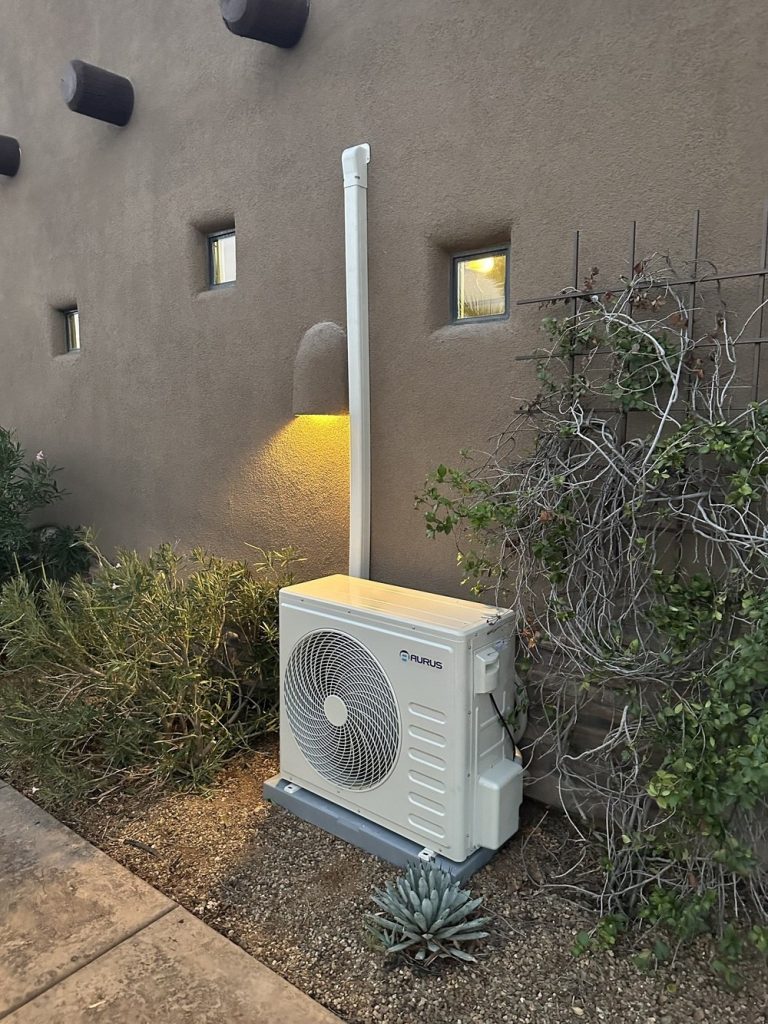
Short answer: A single-zone ductless mini split installed typically runs somewhere around $3,000 to $6,000. A two-zone system commonly lands between $5,500 and $9,000, and three or four zones between $8,000 and $16,000. Each additional indoor head generally adds $1,500 to $3,000. Those are typical market ranges rather than quotes. What actually moves your number is the number of zones, the BTU capacity needed, how far the line sets have to run, and whether new electrical work is required.
Most people looking this up have one specific room in mind. A garage they want to use, a converted Arizona room, a casita, an addition the original ductwork never reached, or a west-facing bedroom that has never once been comfortable in August.
Mini splits are genuinely good at solving that. Here is what it costs and why the range is so wide.
Cost by number of zones
| Configuration | Typical installed range | Common use |
|---|---|---|
| Single zone | $3,000 to $6,000 | One room, garage, casita, addition |
| Two zone | $5,500 to $9,000 | Two rooms off one outdoor unit |
| Three zone | $8,000 to $12,000 | Small home or several problem rooms |
| Four or more zones | $12,000 to $16,000+ | Whole-home ductless |
| Each extra head | +$1,500 to $3,000 | Added to an existing multi-zone |
Typical United States market ranges, not a JB quote. A single zone in an easy location with existing power nearby sits at the bottom of its range. The same capacity three floors from the outdoor unit with new electrical does not.
What actually changes the number
Number of indoor heads. The biggest single factor. Each head is equipment, a line set, a condensate path, mounting and commissioning.
BTU capacity. Sized to the room, not guessed. Bigger capacity costs more, and oversizing is a real mistake, not a safe margin. An oversized unit cools the air fast, shuts off, and never runs long enough to pull humidity out or to distribute evenly. You get a cold, clammy, short-cycling room and shorter equipment life.
Line set length and routing. The refrigerant lines between outdoor and indoor units. A short straight run through an exterior wall is quick. A long run through an attic, around structure, or up a floor takes materials and hours.
Electrical work. Mini splits almost always need a dedicated circuit run from the panel to a disconnect near the outdoor unit. If your panel has capacity and spare slots, this is routine. If it is full, or the home is on older service, it can mean a panel upgrade, and that is a real cost line that surprises people.
This is worth raising early, because it is the thing most likely to change a quote after the fact. We do electrical work in-house, which means the circuit and the HVAC are one job, one crew and one schedule rather than two contractors coordinating.
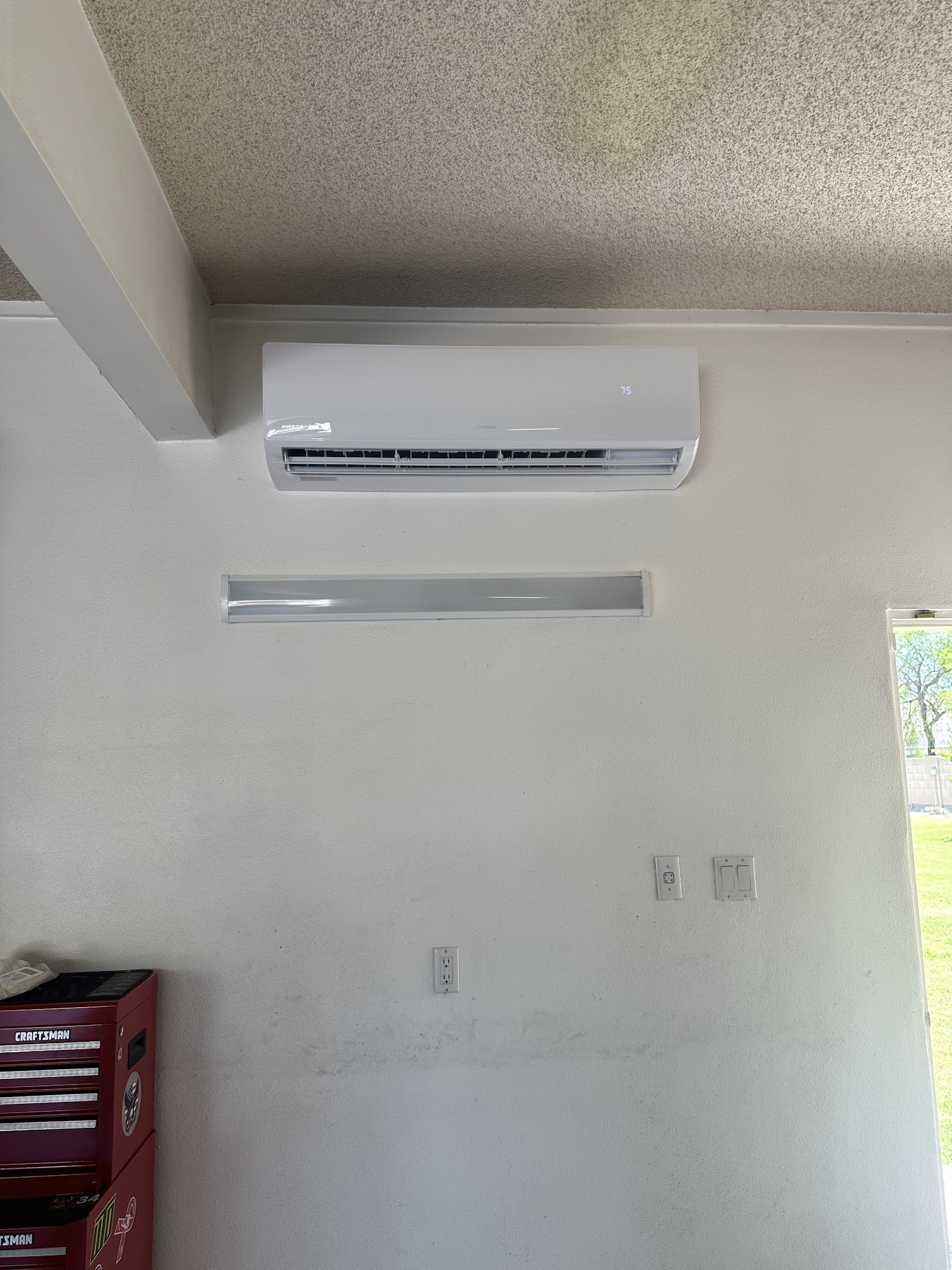
Indoor unit type.
– Wall-mounted is the standard and the least expensive
– Ceiling cassette sits flush in the ceiling, looks better, costs more, and needs the space above
– Floor-mounted suits rooms with limited wall space or big windows
– Slim ducted hides the unit entirely and serves more than one room, at the highest install cost
Efficiency rating. Higher SEER2 equipment costs more up front and less to run. In a climate where the system runs much of the year, that difference compounds faster than it would elsewhere.
Site conditions. Two-story installs, tile roofs, difficult mounting, long condensate runs needing a pump, and restricted access all add labor.
Why Arizona changes the sizing conversation
Design temperature. Equipment is sized against the temperature it has to work in. A unit sized for a mild climate is undersized here, where summer design conditions are far harsher. This is why a national online BTU calculator can leave you with a system that never quite catches up in July.
Garages are the hard case. Uninsulated or lightly insulated, a large door that leaks heat, often a west or south exposure, and frequently a roof with nothing above it. Garage conversions and workshops routinely need more capacity than their square footage suggests. Anyone sizing a garage unit purely on floor area is going to get it wrong.
Heating is the easy part. Mini splits are heat pumps, so they heat as well as cool. In the Phoenix metro, winter demand is mild enough that heating capacity is rarely the constraint. Cooling capacity is what sizing turns on.
Sun exposure and glass matter. A west-facing room with large windows needs meaningfully more capacity than a north-facing room the same size. A proper load calculation accounts for that. A rule of thumb does not.
When a mini split is the right answer, and when it is not
Good candidates:
– A room the existing ductwork never reached, such as an addition, a garage conversion, a casita or a converted Arizona room
– One room that is consistently uncomfortable while the rest of the house is fine
– A home with no ductwork at all
– A space you want to condition independently, like a home office or a workshop, without cooling the whole house
– Somewhere ductwork would be genuinely difficult or destructive to run
Where extending the existing system may be better:
– The room is adjacent to existing ductwork and the current system has spare capacity
– You are replacing the whole system anyway, in which case a properly sized central system with corrected ductwork may serve better
– The real problem is duct leakage or poor insulation rather than capacity. Fixing that is often cheaper than adding equipment, and no amount of new hardware compensates for an attic duct run losing conditioned air
That last one is worth taking seriously. If several rooms are uncomfortable, the honest first question is whether the distribution is failing rather than whether you need another unit.
What a quote should itemize
- Number and type of indoor units, with the BTU capacity of each
- The outdoor unit model and its SEER2 rating
- Line set lengths and routing
- Electrical work, stated explicitly, including whether a panel upgrade is needed
- Condensate handling, and whether a pump is required
- Mounting, brackets or pads
- Permits and inspection
- Commissioning, including refrigerant charge verification
- Warranty on equipment and on labor, stated separately
- Whether registration for the manufacturer warranty is handled for you
Ask how the capacity was determined. The right answer involves the room’s dimensions, insulation, window area and orientation. If the answer is a number pulled from square footage alone, ask again.
A note on DIY kits
Pre-charged DIY mini split kits exist and are genuinely cheaper up front. Two things worth knowing before going that route: most manufacturer warranties require professional installation to remain valid, and the electrical work still needs doing correctly and usually permitting regardless of who mounts the equipment.
If the unit is undersized or the circuit is wrong, the savings evaporate quickly.
Rebates worth checking
Qualifying high-efficiency heat pump equipment may be eligible for federal energy efficiency tax credits, and utilities in the Valley have periodically offered their own rebates on efficient HVAC equipment. Both change, so check current eligibility with your utility and a tax professional rather than relying on a figure from an article. It is worth five minutes before you commit, because the qualifying equipment is not always the equipment you would otherwise have picked.
Frequently asked questions
How much does it cost to install a mini split?
A single zone installed typically runs $3,000 to $6,000, two zones $5,500 to $9,000, and three or four zones $8,000 to $16,000. Each additional indoor head generally adds $1,500 to $3,000. These are typical market ranges; the actual figure depends on capacity, line set routing and electrical work.
Do mini splits need their own electrical circuit?
Almost always, yes. A dedicated circuit runs from the panel to a disconnect near the outdoor unit. If your panel is full or the home is on older service, that can mean additional electrical work, which is one of the most common reasons a quote comes in higher than expected.
Can a mini split cool a garage in Arizona?
Yes, provided it is sized for the conditions rather than the floor area. Garages are usually poorly insulated with a large heat-leaking door and significant sun exposure, so they need more capacity than their square footage suggests. Adding insulation and sealing the door first improves the result considerably.
Is a mini split cheaper than adding ductwork?
Often yes, particularly for one or two rooms, and especially where running ducts would be destructive. For several rooms in a home that already has ductwork and a system with spare capacity, extending the existing system can be the better value.
How long do mini splits last?
Commonly fifteen to twenty years with regular maintenance, though heavy runtime in a hot climate shortens that. Keeping the filters clean and the outdoor coil clear of dust makes a genuine difference here.
What size mini split do I need?
It depends on room dimensions, insulation, window area, ceiling height and sun exposure, not floor area alone. Oversizing is a real problem rather than a safe margin, because an oversized unit short-cycles, removes less humidity and wears faster. A proper load calculation is the only reliable answer.
Get it sized properly
If there is a room in your house that has never been comfortable, we will work out what it actually needs, tell you what the electrical side involves before you are committed, and quote the whole job rather than half of it.
Call JB Industries at (480) 577-5313 or get in touch. We handle mini split systems, installation, AC repair and electrical work across Gilbert, Mesa, Chandler, Tempe, Scottsdale, Phoenix, Glendale, Paradise Valley, San Tan Valley and Gold Canyon. We hold a 5.0 star rating across more than 120 Google reviews.
If your existing system is the thing giving you trouble rather than one stubborn room, start with AC repair cost.